
If you are asking, “Why won’t he commit?” begin by comparing what he says with what he consistently does over time.
When a relationship feels loving but will not move toward the commitment you want, it is easy to make the delay about your value. You may wonder whether being more patient, less demanding, more attractive, or easier to please would finally make him choose the future you have been discussing.
His readiness is not a grade on your worth. Commitment is a decision another adult must be willing to make and live through his behavior. You can influence the quality of a relationship, but you cannot manufacture a genuine yes.
First, define what “commitment” means to you
Two people can use the same word while imagining different agreements. One may mean exclusivity. Another may mean marriage, shared finances, living together, mutual caregiving, or a plan to blend families. Before deciding that he “will not commit,” identify the decision you are actually waiting for.
- What agreement do I want now—not eventually in the abstract?
- What practical changes would that commitment include?
- Which elements are essential to me, and which are preferences?
- What timing would feel deliberate rather than indefinitely postponed?
- Have I expressed this clearly enough for him to answer?
Clarity is not pressure. It is the condition that allows both people to consent to the same relationship rather than quietly living inside different assumptions.
Once you understand the agreement you want, the signs he wants a serious relationship become easier to evaluate.
Why might someone hesitate to commit?
There is no single answer, and the same behavior can arise from very different circumstances. Possibilities include:
- He values independence and imagines commitment as a loss of identity rather than a chosen partnership.
- Past relationships were painful, and he is cautious about repeating them.
- He cares about you but remains uncertain about long-term compatibility.
- He is not emotionally or practically ready for the responsibilities he associates with commitment.
- He fears making the wrong decision and keeps seeking impossible certainty.
- His vision for location, family, money, lifestyle, or marriage differs from yours.
- He does not want this relationship to progress, but has not said so directly.
If his availability seems uncertain beyond the commitment question, it may help to consider whether he is overwhelmed or emotionally unavailable.
These possibilities are context, not conclusions. They should not be used to diagnose him or to select the explanation that allows you to wait the longest. The most useful evidence is what he can say honestly, what he is prepared to decide, and how his choices line up with that answer.
An explanation is not the same as readiness
A thoughtful reason can help you understand him. It does not automatically create a shared future. “My divorce was painful” may explain caution; it does not tell you whether he is now willing to build trust, make agreements, or set a realistic pace. “Work is overwhelming” may be true; it does not answer whether commitment is a goal he shares.
Listen for both self-awareness and agency. Does he describe his hesitation as something he is responsibly examining, or as a permanent fog you are expected to tolerate? Is there a next step he genuinely chooses, or only a reason that resets the waiting period?
Assess words, behavior, and time together
No single sign proves commitment. Look for alignment across three areas.
When his affection, communication, plans, and availability point in different directions, a broader examination of mixed signals from him may be more useful.
1. His words are specific enough to understand
He can say what he wants, what he is uncertain about, and what commitment means to him. He does not rely only on “someday,” “let’s see,” or “why put a label on it?” when he knows you are asking about a serious future.
2. His behavior supports partnership
He makes room for you in ordinary life, follows through on plans, participates in decisions that affect you both, and treats your goals as real information—not as a problem to manage. These behaviors do not replace an explicit agreement, but they show whether his stated intentions have substance.
3. Time is producing information
A period of discernment can be reasonable. Indefinite ambiguity is different. Ask whether the relationship is becoming clearer as you learn more about each other or whether each milestone simply produces another delay.
Have the conversation without making a case for your worth
Choose a calm, private moment and speak from your own goal. You do not need to present a prosecution or a sales pitch.
“I care about you, and I am looking for a committed relationship that includes [name the agreement]. How do you see our future, and what are you genuinely prepared to build?”
If you need a more complete conversation plan, learn how to talk about commitment without pressure or games before choosing your approach.
If he needs time to think, agree on a reasonable follow-up date so the conversation does not remain open-ended. The purpose is simply to obtain information you can use.
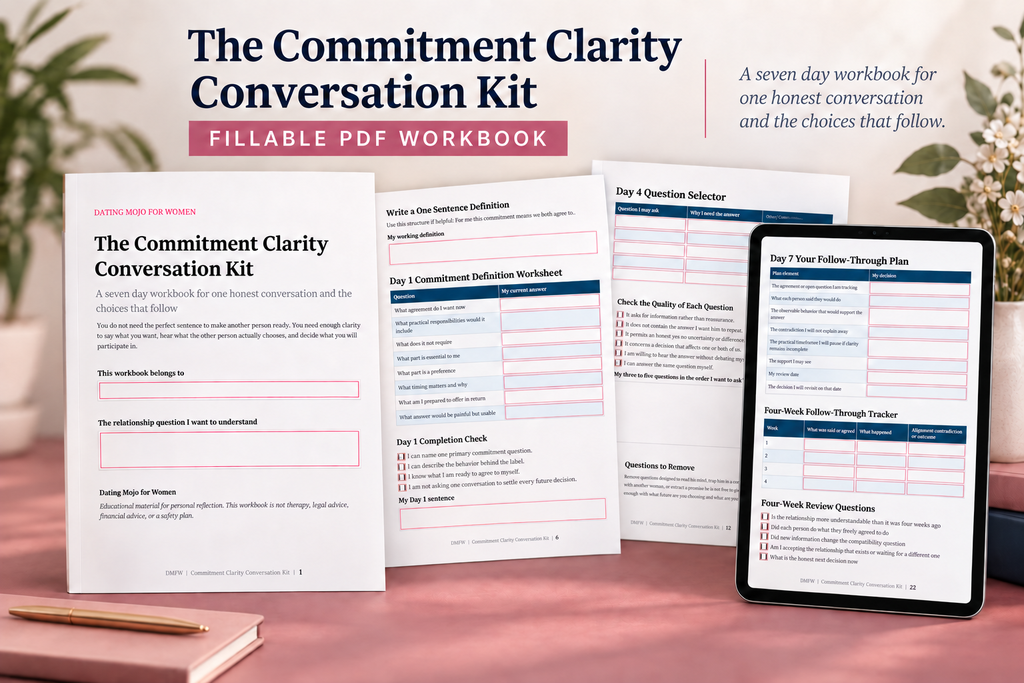
The Commitment Clarity Conversation Kit
Define the commitment you want, prepare for one honest conversation, and reflect on what the answer means for your next step.
$7 USD · Fillable PDF workbook
What a usable answer looks like
A usable answer does not have to be the answer you want. It is direct, internally coherent, and connected to action. “I do not want to marry again” may be painful and very clear. “I want that too; I would like us to discuss living arrangements by November” is also clear enough to evaluate. “Maybe when everything settles down” is not a plan unless the obstacle, next step, and timing become concrete.
Also notice whether he respects your right to want something different. A healthy disagreement can still end a relationship; it does not require either person to be wrong.
When hesitation becomes incompatible goals
Continuing uncertainty may point to incompatibility when:
- He repeatedly avoids or derails a direct discussion.
- His stated future does not include the form of commitment you consider essential.
- Agreed next steps are repeatedly postponed without a new, credible plan.
- You are asked to provide the benefits of commitment while your need for clarity is treated as unreasonable.
- Staying requires you to silence a central life goal or accept open-ended waiting.
- You feel responsible for proving that you are safe, lovable, or undemanding enough to be chosen.
Compatibility is not created by the strength of one person’s hope. Two caring people can want different lives. Recognizing that difference is not giving up; it is responding to reality.
Use a self-directed timeline, not an ultimatum
A timeline becomes coercive when it is delivered as a threat designed to force his decision. A self-directed timeline is different: you decide how long you are willing to remain in the current arrangement, what information you need, and what you will do if the relationship still cannot meet your essential goal.
You may share that timeline honestly, especially when your decision affects him. But its power comes from your willingness to act, not from making the consequence frightening enough to produce a reluctant yes.
Do not confuse a reluctant yes with secure commitment
A commitment obtained through exhaustion, panic, jealousy, financial dependence, pregnancy pressure, or fear of losing access to you may create a label without creating mutual willingness. You deserve a partner who can participate in the decision—not someone whose compliance you must continually enforce.
When pressure or fear is present
If he uses threats, humiliation, financial control, sexual pressure, monitoring, or isolation to keep you in an undefined arrangement—or if discussing commitment feels unsafe—seek confidential support. The central question is no longer how to communicate more persuasively.
Your answer can be clear even when his is not
You may never receive a perfectly articulated explanation. You can still observe whether the relationship is moving toward a shared decision. You can still believe that he cares and conclude that he is not available for the future you want.
The goal is not to win commitment. It is to participate in a relationship whose agreements are mutual, whose direction is discussable, and whose future does not depend on you abandoning yourself while you wait.